Quick verdict
Switzerland's biggest marathon and one of its fastest: a World Athletics Label course that leaves the city for the villages and vineyards of the Geneva countryside, drops to the lake at Cologny with eight kilometres to go and finishes on the Pont du Mont-Blanc with the Jet d'Eau over your shoulder. About 5,000 run the marathon; the half, which starts ninety minutes earlier and runs the same final third, is the bigger race with 7,000 finishers, and a six-leg relay and a Saturday-night 10K share the weekend. Entry is first come, first served and every distance sells out, the half months ahead. Pick it for a spring PB on a course with real countryside in it and a city finish worth the flight.
Course at a glance
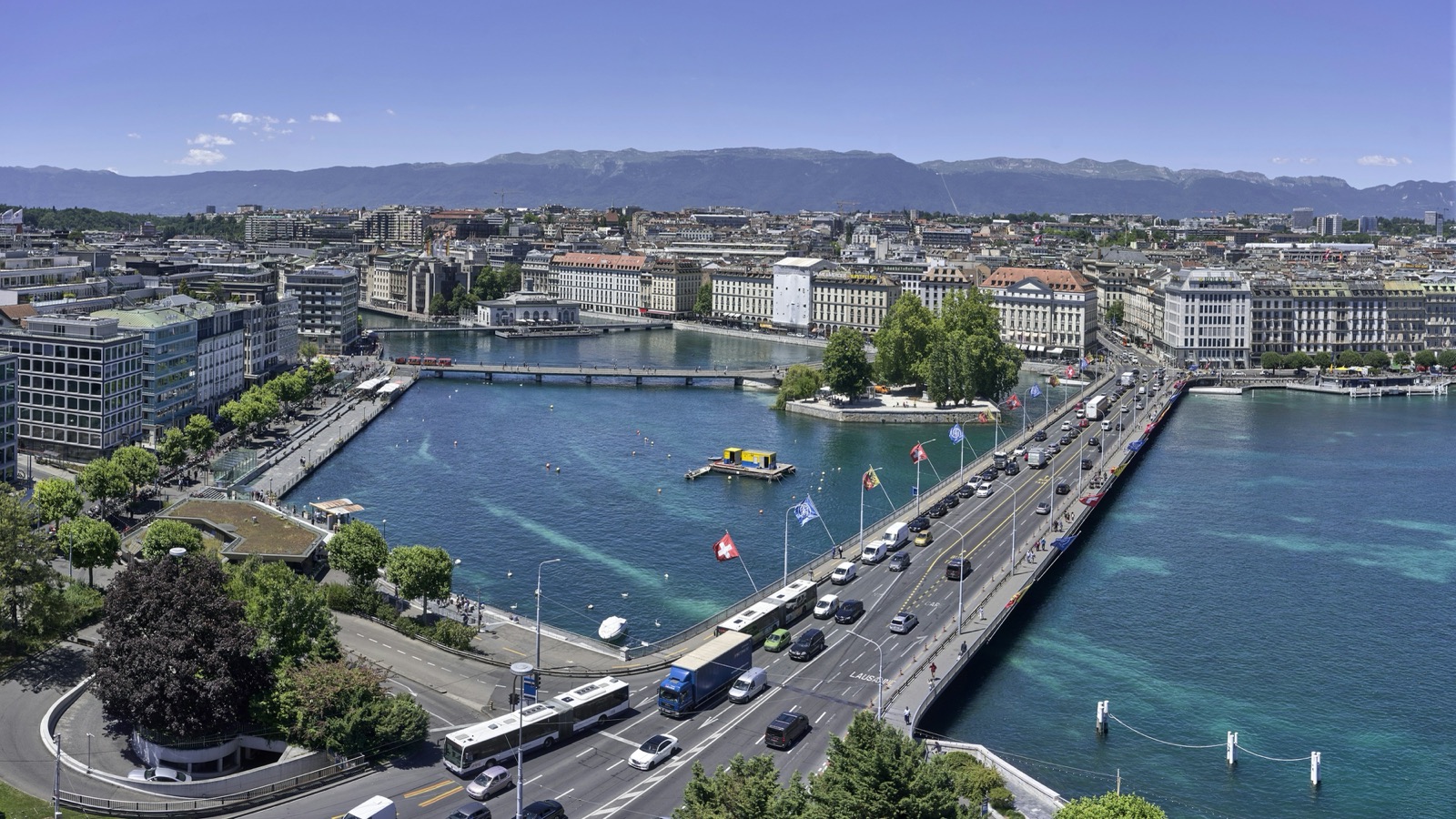
One loop, clockwise, starting on the Route de Frontenex by the Gare des Eaux-Vives, where Geneva meets Cologny, and leaving the city at once: east through Chêne-Bougeries to the first village, Choulex, at 5.5 km, then up through the orchards to Meinier at 11 km and on to the high point of the day, 457 m at Lullier on the Jussy plateau just before 13 km. The course rolls back down through Presinge at 15 km and Puplinge at 17 km to Thônex and Chêne-Bourg at 22 km, the halfway cut-off, then turns north for a second pass through the countryside: the lanes below Vandœuvres, Choulex again at 28 km, Meinier's lower fields and La Pallanterie at 31 km. From Collonge-Bellerive the Route de la Capite drops you 57 m in two kilometres to the shore at Cologny, and the last seven are the lake: the Quai de Cologny, Genève-Plage, the Quai Gustave-Ador past the Jet d'Eau at 38 km, the Jardin Anglais, over the Pont du Mont-Blanc to the right bank, out along the Quai du Mont-Blanc and the Quai Wilson to the turn at 41 km, and back to finish on the bridge. The half starts on the same line at 7:30, takes the short way through Choulex and La Pallanterie to the same descent at 10 km, and runs the whole lakeside finish.
Distances
Half Marathon
21.1 kmMost runThe weekend's biggest race: about 7,200 finishers in 2026, the same start line and the whole lakeside finish, with the plateau cut short.
The Route de Frontenex to Choulex and La Pallanterie, the Route de la Capite down to the lake at 10 km, then the quays, the Jet d'Eau, the right bank and the finish on the Pont du Mont-Blanc.
Entries open · only a few places leftMarathon
42.2 kmThe race itself, and the Swiss championship: about 5,000 entered, around 4,250 finishers in 2025, on one of the fastest courses in the country.
One loop: the villages east of the city twice over, the high point at Lullier before 13 km, the descent to the lake at Cologny from 32 km, then seven kilometres of quays to the Pont du Mont-Blanc.
Entries open · closes 8 May or at sell-out10K
10 kmSaturday night by the lake: the same start, a climb over the Cologny hill and a plunge to the shore, finishing on the Quai Gustave-Ador as the lights come on.
The Route de Frontenex up through Vandœuvres and Cologny to 476 m at 6 km, then 100 m of descent to the lake and the quay to the Jet d'Eau.
Entries openMarathon Relay
42.2 kmFour to six runners on six unequal legs, from 4.5 to 12 km: the way to run Geneva's course with a family or an office.
The marathon course in six pieces, changing at Choulex, Puplinge, Chêne-Bourg, Collonge-Bellerive and the Quai Gustave-Ador, with the whole team allowed over the line together.
Entries openWhere you'll feel it
Not in one place: the plateau is never flat and never steep, and that is the trap. Two small climbs between 7 and 13 km take you to the high point before you have settled, the lanes are open to the sun and to whatever wind is crossing the plateau, and between 23 and 32 km the course sends you back through villages you ran two hours earlier, Choulex twice, Meinier twice, with the spectators thin and the lake nowhere in sight. That is the hard part of Geneva: eight quiet kilometres of countryside when the marathon has started to hurt and the finish is in the other direction. Then the descent at 32 km arrives, 57 m down to the water, and legs that have been rolling for three hours find out what the road has done to them. On a day with the bise blowing down the lake, the quays from Cologny to the finish are the last place you want a headwind, and the right-bank out-and-back from the bridge means you see the finish at 39 km and run away from it.
Best chance to push
The Route de la Capite at 32 km, if you have saved the legs for it: two kilometres downhill, then seven flat along the lake with the first real crowds of the day. The Quai de Cologny at 35, Genève-Plage, the Quai Gustave-Ador with the Jet d'Eau ahead of you at 38, the Jardin Anglais, and the bridge for the first time at 39 km. The right-bank quays to the Quai Wilson turn are wide, dead flat and lined, and the last 400 m back onto the Pont du Mont-Blanc are the finish straight Geneva built the race around. More than half the field sets a personal best here; this is where they do it.
Three things to know
- Entry is first come, first served, with no ballot, no charity places and no tour operators, and it sells out: the half has closed months before race day in recent years and more than 10,000 runners sat on waiting lists for the last edition. Pre-register in May for the next edition and you get a day's head start when general sales open in mid September; the price steps up through the autumn and winter. No transfers, no late entry, and cancellation cover is only sold at the moment you enter. Swiss and Liechtenstein nationals in the marathon are entered in the Swiss championship automatically.
- Race morning starts at the Stade de Richemont on the Route de Frontenex, five minutes' walk from the Gare des Eaux-Vives on the Léman Express and trams 12 and 17, and your bib voucher doubles as a free return ticket across the Geneva network on race day. Corrals go by the time you predicted at entry, colour-coded on the bib, and close before the gun. There is no bag drop at the start: bags go in on the Quai Gustave-Ador, opposite the Rue Muzy, a 1.2 km walk away, between 7:00 and 8:30 for the marathon, and come back at the finish village in the Jardin Anglais, where you also collect your bib on the Friday or Saturday. Nothing is handed out on the Sunday.
- Eleven aid stations, at 5.5 km then roughly every four, serve Eau de Genève from fountains and reusable cups, with isotonic drink and gels from 10.5 km and fruit and biscuits throughout: carry a soft flask and the fountains are faster than the queue. Cut-offs fall at 22 km after 3:10 and at 32 km after 4:35, pacers run every quarter hour from 3:00 to 4:30 plus 5:00, and the half has its own from 1:30 to 2:10. The relay is four to six runners on six legs of 5.5, 12, 4.5, 9.6, 6.1 and 4.5 km, changing at Choulex, Puplinge, Chêne-Bourg, Collonge-Bellerive and the Quai Gustave-Ador, with shuttles from the Gare des Eaux-Vives to the handovers.
Race-day weather
Early May in Geneva is cool at the start and mild by the finish: around 11 to 13°C on the Route de Frontenex at nine, the high teens along the quays by the time the back of the marathon reaches the lake, and a warm edition can touch the low twenties in the afternoon sun. May brings measurable rain on roughly one day in three, usually a shower rather than a wet morning. The two things that matter are shade, of which the plateau has almost none, and the bise, the dry north-easterly that funnels down the lake a few days a month and turns the lakeside finish into a headwind.
What runners wear
Short sleeves or a singlet and shorts, with arm warmers you can push down once the first climb has warmed you, and a throwaway layer for the corrals: the stadium pens fill from 8:15 in the morning shade and there is no bag drop at the start, so whatever you are wearing at nine is yours to carry or lose. A cap and sunscreen on a clear day, since the countryside is open from Choulex to La Pallanterie. Racing flats: it is tarmac throughout, measured and certified, and the descent at 32 km is the only place you will think about your shoes.
Typical finish times
The course records are 2:06:59 and 2:24:19, both from 2021, and the winners usually come home around 2:09 and 2:31. Behind them the marathon had about 4,250 finishers in 2025, a quarter of them women, with a six-hour limit that catches very few. The half, with records of 1:01:39 and 1:05:44, brought home about 7,200 in 2026, more than the marathon, and its three-hour limit is generous. The organiser's own figure is that more than half the field sets a personal best, and the average age of a Geneva marathoner has fallen to 36.
Worth the trip?
Yes, for a fast spring marathon that is easy to get to and easy to run well: the airport is seven minutes from the main station by train, the finish is an eight-minute walk from it, and the course is a label-certified loop with proper countryside in the middle and a lakeside finish most races would kill for. It is not a big-city marathon and does not pretend to be: the first 31 km are village lanes and vineyards with support in pockets, you pass through Choulex twice, and the crowds arrive with the lake. Enter the week sales open, run the Saturday-night 10K the day before if you have a friend who wants a race, and keep the Sunday afternoon for the Jardin Anglais.
Save Geneva Marathon to your season and RunCalendar reminds you the morning entries open and before they close. Free on iPhone, no account needed.
Written by RunCalendar from the organiser's own published information and past editions. Entry states are checked nightly; everything else is written to last the season. This page is rebuilt every night from the RunCalendar catalogue.